This series of 5 pictures are the second part of the Hadrian's Wall photos. I visited 2 sites, Vindolanda and Birdoswald. Both of these are forts and both are no more than 'hip high' with respect to what remains. I've read it wasn't until after the Norman invasion that the large scale dismantling of the wall started. The easily gathered, finely shaped stones were a source of excellent building material necessary for the architecture and building techniques the Normans brought with them. It's ironic the quality and strength of the wall material is what ultimately lead to it's destruction.
Saturday, 27 June 2009
This series of 5 pictures are the second part of the Hadrian's Wall photos. I visited 2 sites, Vindolanda and Birdoswald. Both of these are forts and both are no more than 'hip high' with respect to what remains. I've read it wasn't until after the Norman invasion that the large scale dismantling of the wall started. The easily gathered, finely shaped stones were a source of excellent building material necessary for the architecture and building techniques the Normans brought with them. It's ironic the quality and strength of the wall material is what ultimately lead to it's destruction.
Thursday, 25 June 2009
I've been to several new sights, but I particularly enjoyed the North East; Durham on Palm Sunday weekend (which included a day along the Hadrian's Wall sites) and a long weekend to visit Newcastle and the coastal sites between Newcastle-upon-Tyne and Berwick-upon-Tweed.
I'll start by posting a couple of pictures of Durham. The Cathedral with the river in the foreground, the Castle, high on the ridge, 2 pictures of the old city center and a picture from the park high above the rail station, cathedral in the center.
Sunday, 17 May 2009
Hello all. I haven't posted anything lately but it isn't because I haven't been busy. For this post I'll just enter a few new pictures of my latest hobby; hiking through the fells. I took a short course, very short, on using a map and compass to navigate through the fells. To be able to read the map, shoot a bearing to verify your position on the map, is a very important skill to master if I'm going to go on hikes by myself. Actually didi one today. I climbed the Old Man of Coniston, about 2600 ft high (803 meters) and within ten minutes of getting to the top, the clouds rolled in and swallowed the landscape. Visibility went to zero and it was more good sense and luck that got me to where I needed to be. Here are some views of the lakes from a high vantage point.
Wednesday, 4 March 2009
Several weeks back I visited the city of Chester. About 2 1/2 hours from here, east and south of Liverpool, Chester is a walled city that dates back to the Roman era. The amphitheatre is one of the largest outside of Rome. Another great landmark of Chester is its cathedral. Smaller and a bit more intimate than York (I think), Chester is a wonderful city.
The cathedral at Chester has become my favorite. The red hue of the stone casts an air of humility and simplicity that is in direct opposition to the majesty of this house of worship.
As in York, the wall around the city can be walked. It takes about 40-50 minutes, York took 90. This is a view of the roman garden ruins.
Just inside the city wall, I thought this would be a nice place to live, just in the shadow of the cathedral.
Double click on this picture and see if you can read the inscription just above the coat of arms. It's the perfect example of what a bad day can be.
There's a canal that runs across the north end of town. Still operational (as most of them are), the locks interested me because they are all manual, self service, and the heavy lock gates are perfectly balanced so once you get them moving, you can keep them moving with one hand.
Lot's of shopping in Chester, and lots of people. The store fronts have a minimum of 2 levels for shops.
This is Chester at 6:30 am on a sunday morning. I was the only one up and about.
Several buildings in Chester are of the 'Tudor' style. These are the real thing!
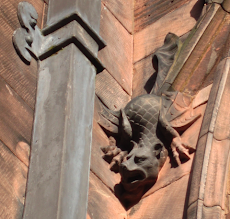
This is a detail of the building above; there were several carvings like this just about every 10 feet or so.
Just a short ride from here is the village of Cartmel. It is noted for its Priory, which dates back to the 12th century. Cartmel is a lovely village, quiet and yet awesome in its rich historical heritage.
Just outside of town, it get pastoral and sparsely populated very quickly.
A view from the town's outskirts.
Looking back at the Priory from the center of town.
Subscribe to:
Posts (Atom)